Plasterboarding
Dry Lining and Plasterboarding for Renovation Work
Plasterboarding for extensions, loft rooms and renovation work.
25 years’ experience · Greater Manchester & surrounding areas
Got an extension or loft that's ready for boarding?
Once the structure is up and the first fix is done, everything stops until the walls and ceilings go on. Boarding is the point where a building site starts looking like rooms.
It's also where a lot of later problems are created or avoided. Boards fixed on a wonky line, joints landing in the wrong place or a ceiling that isn't level all show up the moment the plaster goes on — and by then it's expensive to fix.
Getting the boarding right first time
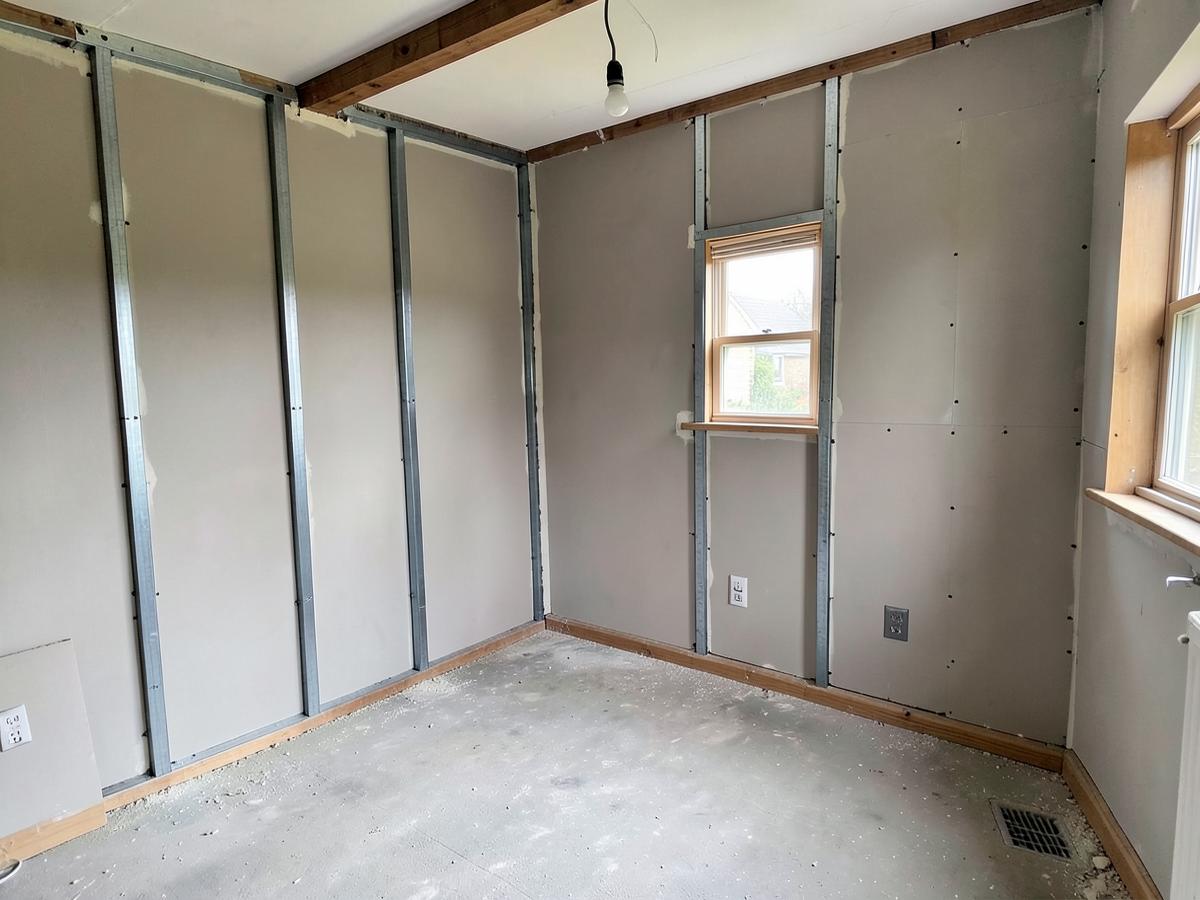
Walls are set out so boards land on solid fixings and joints are staggered rather than lining up. Where the existing masonry is uneven, boards are dot-and-dabbed or battened out so the finished face runs true.
Board choice matters: moisture-resistant board in bathrooms and kitchens, fire-rated board where required, and insulated board on cold external walls. Ceilings get fixed at the right centres so they don't sag between joists.
Joints are scrimmed and beads fixed to external angles and reveals, leaving everything ready to skim straight away — usually as one continuous job so there's no waiting between trades.
Typical dry lining work
Interior projects of all sizes across Greater Manchester and surrounding areas.
House extensions
New rooms boarded throughout and finished ready for decorating.
Loft conversions
Sloping ceilings, dwarf walls and awkward angles set out properly.
Stud partitions
New walls boarded where rooms are being divided or reconfigured.
Overboarding ceilings
Old cracked ceilings covered rather than pulled down.
Insulated dry lining
Thermal board on cold external walls in older properties.
Dot and dab
Boarding straight to masonry to create a flat, dry surface.
Why it pays to have the same trade board and plaster
- The person boarding knows exactly what the plaster needs
- No arguments between trades about whose problem an uneven wall is
- Joints, beads and angles set out for a clean finish
- Faster overall — boarding straight into skimming
- Warmer, quieter rooms where insulated board is used
- A flat, true surface for kitchens, wardrobes and tiling later
How it works
Getting a price for dry lining
- 01
Tell us about the job
Send some basic details — what needs doing and roughly how big it is.
- 02
Send photos
Upload photos if you have them so the job can be understood properly.
- 03
Discuss the work
AC Plastering Services can assess what's required and talk it through with you.
- 04
Arrange the work
Agree the next steps and get the plastering booked in.
Do you provide dry lining?
Yes — plasterboarding to stud walls, ceilings, extensions and loft conversions, plus dot-and-dab onto masonry, ready to be skimmed.
Should boards be taped and jointed or skimmed?
Both are used. A skim gives a seamless, harder surface and is the usual choice in homes. Tape and joint suits some commercial or fast-track jobs. It's worth deciding before boarding starts.
Can dry lining help with a cold or uneven wall?
Yes. Insulated boards can be used on cold external walls, and battening out lets a badly bowed wall be brought back to a true, flat plane.
Can you board over an old ceiling?
Often, yes. Overboarding a cracked or sagging lath and plaster ceiling is frequently cleaner and quicker than pulling the whole thing down.
Do you cover my area?
Dry Lining is carried out throughout Greater Manchester and the surrounding areas — Manchester, Salford, Stockport, Trafford, Sale, Altrincham, Bury, Bolton, Oldham, Rochdale, Tameside and Wigan among others.
Need dry lining doing?
Tell us what needs doing and send over a few photos if you have them.
Telephone number is a placeholder until supplied.